“In the digital realm, nothing is ever truly lost. It merely waits for an intellect sharp enough to decipher the silence. While the masses see a forgotten void, the visionary sees a vault waiting for the right key. Success isn’t about luck; it’s about having better tools than the other guy.”

Let’s face it: the early days of Bitcoin were the Wild West. People were mining thousands of coins on dusty laptops, storing them in “wallet.dat” files, and then—oops—formatting their hard drives to install World of Warcraft. Back then, BTC was worth less than a pizza. Today? That same dust is worth a small island in the Pacific. We are talking about dormant wallets that have been sleeping since Satoshi was still posting on forums.
The problem is massive. Estimates suggest that nearly 20% of all Bitcoin is sitting in limbo. That’s billions of dollars, locked away by forgotten passwords and misplaced seed phrases. It’s the ultimate treasure hunt, but instead of a map, you have a cryptographic puzzle that would make Turing sweat. These aren’t just “lost funds”; they are unclaimed bitcoin reserves that act as a deflationary black hole for the market.
Why Millions of BTC Remain Dormant and Unclaimed
Human error is the undefeated champion of lost crypto. People died without passing on keys, threw away hard drives (shoutout to that guy in the UK digging up a landfill), or simply wrote their 12-word phrase on a napkin that went through the wash. These dormant wallets serve as a graveyard of wealth. But here’s the kicker: the blockchain doesn’t care. The coins are there, visible on the ledger, mocking everyone with their immutability.
For the average Joe, a lost key is a tragedy. For a hacker armed with the right tech, it’s a challenge. The blockchain is public; the balances are public. The only thing missing is the magic string of words. And as long as those coins don’t move, they are theoretically up for grabs if—and only if—you can reverse-engineer the access. It’s not theft; it’s digital archaeology.
The Financial Impact of Forgotten Seed Phrases
When a seed phrase is forgotten, that liquidity is removed from the economy effectively forever—unless recovered. This scarcity drives up the price for everyone else (thanks for hodling, accidental diamond hands), but it also represents a colossal inefficiency. We are talking about forgotten seed phrases that guard access to generational wealth.
Imagine finding an old wallet from 2011 with 50 BTC. In 2011, that was lunch money. Today, that’s “buy a lambo and retire” money. The financial impact is personal catastrophe for the loser, but potential lottery-winning joy for the recoverer. This asymmetry is where the new wave of crypto recovery tools comes into play. We are moving from weeping over lost keys to hunting for them.
“Wealth flows to those who reduce entropy. A lost wallet is chaos. Recovering it is bringing order to the universe. Do not feel guilt for finding what was abandoned; feel pride in restoring value to the system.”
Current Challenges in Bitcoin Wallet Recovery
Traditionally, trying to crack a Bitcoin wallet was like trying to guess the exact atom choice in the entire universe. The math is brutal. Brute force attacks—where you just try every combination—are mathematically impossible for a full 12-word seed phrase. The heat death of the universe would happen before you cracked one single wallet using standard computation. It’s strictly for the dinosaurs.
Most “recovery services” today are scams or manual laborers who ask you, “Did you use your dog’s name?” That’s not hacking; that’s social engineering with a notepad. True Bitcoin wallet recovery requires more than guessing birthdays. It requires computing power and intelligent algorithms that can slice through the impossibilities.
Limitations of Traditional Recovery Methods
The old school method relies on the user remembering *part* of the password. “Oh, it starts with ‘P’ and ends with ‘123’!” Great, we can brute force that. But for a completely lost mnemonic phrase? Good luck. The search space for BIP-39 seed phrases is 2048^12. That number is so big it makes astronomers uncomfortable.
Traditional scripts run linearly. They check a million phrases a second. Sounds fast? It’s not. It’s a snail racing a fighter jet. You need trillions of checks. Without AI optimization, you are just burning electricity for fun. This inefficiency is why 99% of people give up. They think it’s impossible because they are using stone tools in the space age.
Famous Cases of Lost Bitcoin Wallets
We all know the stories. Stefan Thomas, the programmer with hundreds of millions in BTC locked on an IronKey, having only two password guesses left. Or James Howells, the landfill guy. These aren’t just anecdotes; they are proof of the system’s ruthlessness. These wallets are sitting there, heavily monitored. If one of them moves a single satoshi, Twitter (or X, whatever) melts down.
These famous cases highlight the desperate need for a solution that bypasses human memory entirely. If Stefan had an AI tool that could analyze his keystroke patterns or generate likely seed variations based on 2011-era randomization flaws, he might be sipping mojitos on his yacht instead of having panic attacks.
“The impossible is just a lack of data processing power. While the world sees a dead end, the algorithm sees a probability curve. Position yourself on the right side of the curve.”
The Role of AI in Revolutionizing Crypto Recovery
Enter the game-changer: Artificial Intelligence. We aren’t talking about ChatGPT writing poems here. We are talking about specialized neural networks designed for crypto recovery. AI doesn’t just “guess”; it learns. It analyzes patterns in random number generation (RNG) used by old wallet software. It understands that humans (and early software) are terrible at being truly random.
Tools like the AI Seed Phrase Finder are rewriting the rules. Instead of checking every grain of sand on the beach, the AI predicts where the treasure chest is buried. It uses massive datasets of known addresses and leakage patterns to narrow down the search field from “infinite” to “plausible”. This is the difference between a blindfolded dart throw and a laser-guided missile.

How AI Seed Phrase Finders Work for Abandoned Wallets
So, how does this black magic work? The AI Seed Phrase Finder utilizes a cluster of neural networks. One part optimizes the generation of mnemonic phrases, avoiding combinations that are statistically unlikely to be valid wallets. Another module checks these generated phrases against the blockchain at lightning speed to see if they hold a non-zero balance.
It exploits the “weak randomness” of older wallet generators. In the early days, entropy wasn’t as robust. The AI detects these subtle patterns—fingerprints left by the software that created the wallet. It’s like finding a master key that opens 1% of the doors, but when there are a billion doors, 1% is a fortune. This tech effectively automates the hunting of abandoned wallets.
Benefits of AI for Quick and Ethical Recovery
Speed is the name of the game. An AI grid can process what a standard server farm would take years to do in mere days. This speed translates to quick recovery. If you are looking to recover your own assets or find lost liquidity, time is money.
Ethically, this is fascinating territory. We are talking about recovering assets that are effectively dead. By bringing this crypto back into circulation, you are actually aiding the market liquidity. Plus, let’s be real: if you use a tool to recover a wallet you lost access to, that’s just smart. And if the tool finds a wallet that has been dormant for 12 years with no owner claim? Well, possession is nine-tenths of the law, and the private key is the other one-tenth.
“Money is just information moving through a network. If you can decode the information, you capture the value. Stop working for money and start making the network work for you.”
Advantages of AI Tools for Finding High-Value Dormant Wallets
Let’s talk turkey. Or rather, let’s talk Lambos. The primary advantage of using high-end AI tools is the potential for high-value dormant wallets. We aren’t looking for dust. The AI can be configured to filter for wallets holding specific amounts—say, 1 BTC or more. This targeted approach means you aren’t wasting resources cracking a wallet with $0.05 in it.
This opens the door to insane passive income opportunities. Imagine setting up a rig, launching the AI Seed Phrase Finder, and going to sleep. You wake up, check the logs, and see a green notification: “Success. Balance: 14.2 BTC.” That’s not just a payday; that’s a life change. This is the reality for those leveraging computational superiority.
Unlocking Dormant Liquidity and Passive Income Opportunities
The concept of “passive income” usually implies low returns. Not here. Recovering a single abandoned asset can dwarf a lifetime of 9-to-5 wages. The AI tools operate autonomously. They are the digital equivalent of metal detecting, but your metal detector covers the entire planet and the gold nuggets are the size of cars.
By unlocking this dormant liquidity, users of these tools are arguably performing a service. They are recycling lost value. Of course, the primary motivation is the massive profit margin. The ROI on a license for top-tier recovery software vs. the potential find is a calculation that makes venture capitalists drool.
Ethical Considerations in Recovering Abandoned Assets
Is it a gray area? Maybe. But consider this: A wallet untouched for 15 years, with no activity, arguably has no owner. In the maritime world, salvage laws apply to shipwrecks. If you find it, you claim it. The blockchain is the new high seas. Ethical recovery focuses on the idea that these keys are lost to time.
However, the primary legitimate use is always self-recovery or client-assisted recovery. But let’s be honest among friends—if the AI finds a key to a generic, anonymous wallet from 2010, nobody is going to report it to the “crypto police.” The code dictates control. Not your keys, not your coins; but if you find the keys… they are your coins.
“History doesn’t remember who followed the rules; it remembers who wrote the new ones. In the decentralized world, the only rule is the consensus protocol. Everything else is just a suggestion.”
The Future Landscape of AI-Powered Bitcoin Recovery
We are just scratching the surface. The future of Bitcoin recovery is going to get weirder and faster. As AI models like GPT-4 and beyond evolve, their ability to predict human behavior (and thus password creation) will become terrifyingly accurate. We are moving toward AI forensics that can de-anonymize wallet owners and reconstruct seed phrases from fragmented data.
The “AI Seed Phrase Finder” is the pioneer, but the landscape is shifting. We will see integration with quantum-resistant algorithms (eventually) and even smarter heuristic scanning. The tools available today will look like toys in five years, but today—right now—they are the absolute apex of what civilians can access.
Emerging Technologies for Mnemonic Phrase Recovery
Expect to see hybrid systems. Systems that combine GPU brute forcing with AI predictive logic. Mnemonic phrase recovery will become a service offered by banks (ironic, right?) using this very tech. But for now, it lies in the hands of the agile and the tech-savvy.
New techs are emerging that analyze blockchain transaction graphs to identify “zombie” wallets that are statistically vulnerable. The AI targets these specifically, wasting zero time on secure, modern wallets. It’s a predator-prey evolution, and right now, the AI is the T-Rex.
How AI Will Unlock More Million-Dollar Wallets
The supply of lost Bitcoin increases every year. People are careless. As the price rises, the incentive to find these million-dollar wallets skyrockets. AI will unlock these not by magic, but by relentless, optimized probability. It will solve the puzzle pieces that humans can’t even see.
We are entering an era where losing your keys isn’t a death sentence, but finding someone else’s lost keys is a career path. The tech is scaling. The computing power is cheap. The potential rewards are infinite.
Getting Started with AI Crypto Recovery Tools
Enough theory. You want to know how to get your hands on this digital pickaxe. Getting started with AI crypto recovery tools is easier than you think. You don’t need a PhD in cryptography. You need a decent PC, a stable internet connection, and the right software.
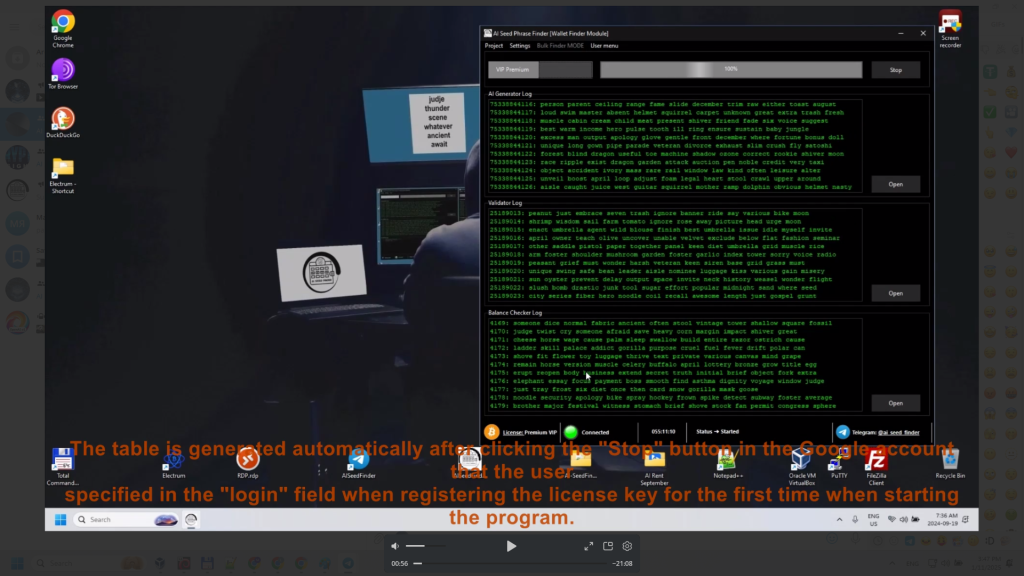
The AI Seed Phrase Finder is designed with a user-friendly interface. It hides the complex math behind a dashboard that basically says “Start” and “Stop”. But don’t let the simplicity fool you; under the hood, it’s crunching numbers that would burn out a supercomputer from 2005.
Step-by-Step Guide to Using AI Seed Phrase Finders
- Acquire the Software: Visit the official site (you know the one, ai-seedfinder.com). Don’t download cracked versions from shady forums; they’ll just steal your coins.
- Configure Your Target: Set the parameters. Are you looking for specific address types (P2PKH, P2SH)? Are you targeting “dormant” status?
- Run the AI Engine: Hit the button. The system will connect to the remote GPU cluster (or use yours) and start the mnemonic phrase recovery process.
- Wait for the Hit: This is the passive part. Go live your life.
- Verification: When a match is found, the software will output the seed phrase and the associated private key. Verify the balance on a blockchain explorer (use Tor if you’re paranoid).
- Sweep funds: Immediately move the funds to a secure, fresh wallet.
Tips for Maximizing Earnings from Recovered Wallets
To really crush it, you need to think big. Don’t stop at one instance. Run multiple instances if your hardware supports it. Focus on legacy addresses (starts with ‘1’), as these are most likely to be lost/dormant since 2010-2013.
Also, patience is key. AI is fast, but the search space is vast. It might take a day, it might take a month. But remember: one hit pays for the electricity for a thousand years. Stay consistent, stay secure, and keep your own keys safe while you hunt for others.

“The future belongs to the curious. While others debate the morality of the tool, the pragmatic use it to build empires. The blockchain is the ultimate truth machine. Be the one who turns the handle.”